After Nepal’s defeat in the Anglo-Nepal War, the Sugauli Treaty compelled Nepal to cede claims on the territories west of the Mahakali River. The treaty maintained complete sovereign right of Nepal on the river. Since the signing of the Mahakali Treaty, however, the river has been recognized as a “boundary river on major stretches between the two countries”. The following timeline of the Mahakali River (heavily based on Gyawali & Dixit, 2000 and Shrestha, 2025) shows that Nepal went from a 100% right to legally 50%, and practically less than 1% (details in upcoming articles). It is an agonizing tale of two centuries of neglect, mismanagement, and treason.
Timeline of the Mahakali River Use
A historical overview of treaties, agreements, and events surrounding the Mahakali River.
The Sugauli Treaty concluded to end the Anglo-Nepal War during the premiership of Bhimsen Thapa, defined the national frontiers of present-day Nepal and established the Mahakali River (referred to as the Sarada River in India) as the western boundary between Nepal and British India.
Following the Sepoy Mutiny of 1857 and Jung Bahadur Rana‘s assistance in its oppression, the British gifted the southern reaches of the river back to Nepal.
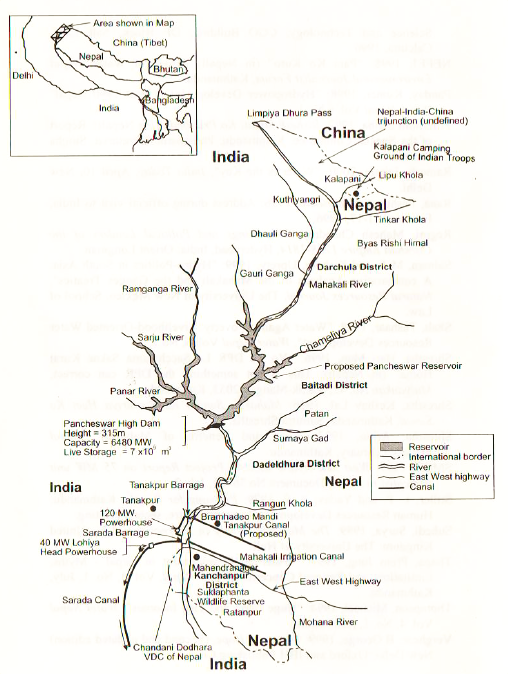
The main channel of the Mahakali River shifted eastwards, turning the present-day Chandani-Dodhara into an island1. The British India government ordered a re-alignment of the boundary in 1909, with demarcations completed by February 1912.
Exchange of Letters (EOL) commenced regarding the construction of a barrage at Gaddachouki-Banbasa in the Mahakali River after the Resident of British India to Nepal, J. Manners Smith, wrote to Prime Minister Chandra SJB Rana.
The Sarada “Treaty” concluded with EOL between Chandra SJB Rana and Colonel Kennion. Nepal agreed to transfer 4,000 acres of the Mahakali’s eastern banks to India so it could build the Sarada Barrage. In exchange, Nepal received forested land, Rs 50,000, and specified allowances for water withdrawal.
India extended the left afflux bund of the Sarada Barrage about 100 meters beyond border pillar BP 6A into Nepali territory.
Using a loan from the World Bank, Nepal planned and commenced the Mahakali Irrigation Project to utilize the share of water as permitted under the 1920 Sarada Treaty. The project did not get ahead and was cancelled in 1989.
Tanakpur Barrage Project
1983: India finished the technical study for a 120 MW hydroelectric project near Tanakpur, prompting Nepal to raise concerns about potential damage to Nepali land and its Mahakali Irrigation Project.
1988: India completed the construction of the Tanakpur Barrage and Powerhouse on its side (the right afflux bund).
Amidst anti-regime protests by Nepali Congress and Left Front in Nepal, a draft proposed by India to amend the 1950 Treaty of Friendship included clauses on the joint use of rivers and water resources. Nepal refused.
End of the Panchayat System.
Joint communique released during the visit of the interim government’s PM Krishna Prasad Bhattarai to India included the phrase “common rivers” in the spirit of the March 31 draft treaty.
Formation of a technical team by the Minister of Water Resources Mahendra Narayan Nidhi to review the Tanakpur problem.
The technical team recommended Nepal could agree with India on minimizing submergence in Nepal while meeting Indian requests.
May 12: General Elections.
May 17: Indian PM Chandra Shekhar asked for permission to build the left afflux bund on the Nepalese side.
May 27: Girija Prasad Koirala heads the government.
Nepali PM GP Koirala replied that permission regarding the left afflux bund of Tanakpur could only be given after detailed study and agreement.
During the visit to New Delhi at the invitation of the Indian PM PV Narasimha Rao, PM Girija Prasad Koirala entered into an ‘understanding’ allowing India use of 577 meters of Nepali territory for the Tanakpur Barrage left afflux bund. Koirala called it a mere understanding, not a formal treaty.
Dec 15: PM Koirala promised to make the contents of the understanding public.
Dec 16/17: India begins construction.
Dec 17: Writ filed by Advocate Bal Krishna Neupane at Supreme Court arguing it required parliamentary ratification.
Dec 23: Understanding published in Nepal Gazette2.
March 293: UML MPs, led by Bharat Mohan Adhikari occupied the HoR rostrum for 7 hours.
Sept 9: Eight communist factions demanded parliamentary ratification of the Tanakpur Understanding.
Oct: Indian PM Narasimha Rao ‘renegotiated’ Tanakpur, increasing “free” electricity to Nepal from 10 to 20 million units.
Dec 15: Supreme Court ruled that the understanding of December 1991 was a treaty requiring ratification by the parliament.
Lok Raj Baral Commission formed to fix criteria on whether river agreements constituted “pervasive, serious and long-term” issues.
Mar 1993: Amidst attempts to ratify the Tanakpur Understanding through simple majority of the parliament, Ganesh Man Singh wrote: “Passing the Tanakpur Treaty by a simple majority of the lower house of the parliament would be equivalent to signing a death warrant. My conscience prevents me from putting my signature to it. Please do not compel me to go against my conscience.”
Jul 1994:Koirala government fell.
Nov 30: UML minority govt formed after mid-term elections.
Apr 4: UML put forth a “package deal” including a 6840 MW Pancheshwar Dam.
The draft treaty created a false narrative about the Mahakali River being a border river. It said, “Mahakali is basically a border river between two countries, and both the countries are entitled to an equitable share in its use.”
Aug 28: After Manmohan Adhikari recommended dissolution of the parliament, the Supreme Court ruled that a minority prime minister does not have the right to dissolve the parliament as long as there are other possibilities of coalitions, reinstating the parliament. Sher Bahadur Deuba government was formed with a coalition between the NC, the RPP, and Sadbhawana.
Nov 17: Deuba presented a similar draft treaty as the UML.
Jan 26: The meeting of the three major parties: UML, NC, and RPP outside the parliament/parliamentary committee reached the “National Consensus on the Use of the Waters of the Mahakali River”. The signatories were: Madhav Kumar Nepal and Khadga Prasad Oli from the UML; Chiranjivi Wagle and Bimalendra Nidhi from the NC; and Prakash Chandra Lohani (Foreign Minister) and Pashupati SJB Rana (Water Resources Minister) from the RPP.
Jan 29: Foreign ministers of Nepal and India, Prakash Chandra Lohani and Pranab Mukherjee, respectively signed Mahakali Treaty (formally the Treaty concerning the Integrated Development of the Mahakali River Including Sarada Barrage, Tanakpur Barrage and Pancheswar Project).
Feb 12: The Prime Ministers of Nepal and India, Sher Bahadur Deuba and P.V. Narasimha Rao, re-initialled the Mahakali Treaty in Delhi.
Feb 13: CPN Maoist, led by Pushpa Kamal Dahal, and United Front, led by Baburam Bhattarai united and declared “People’s War”. The second of their forty demands was the repeal of the Mahakali Treaty.
Feb 17: Indian Secretary of Power S. Abraham and Nepali Secretary of Water Resources Dwarika Nath Dhungel signed an umbrella “agreement between His Majesty’s Government of Nepal and the Government of India concerning the electric power trade”.
Apr 10: UML formed the Oli Commission to study the Mahakali Treaty and its implications although the party had already welcomed the signing of the treaty.
Aug 20: Water Resources Minister Pashupati SJB Rana tabled the Mahakali Treaty for ratification in the parliament.
~ Aug 26: During their separate visits, the British Minister of State for Parliamentary Affairs Liam Fox and the US Assistant Secretary of the State for South Asia Robin Raphael hinted that non-ratification of the Mahakali Treaty would send a wrong signal and drive away private international investments in Nepal.
Sept 2-9: Oli Commission reported the presence of Indian troops in Kalapani in the headwaters of the Mahakali River. The UML split into two factions. The majority claimed that the treaty should be ratified and the flaws solved during the preparation of the DPR. The minority argued that the problems should be resolved completely before the ratification.
Sept 10: The Secretary General of the UML wrote a letter to HMG asking for its and the Indian government’s written commitments on their 13-point demand regarding the Mahakali River. Foreign Minister Prakash Chandra Lohani wrote a letter to the Indian ambassador seeking clarification of the issues raised by the UML. The ambassador refused to comment on the issues.
Sept 11: Prime Minister Deuba replied to the UML Secretary General that the issues were either covered by the treaty or would be handled by technical teams to be constituted between two governments.
Sept 19: The Indian Ambassador, in the second letter, assured that the government of India would cooperate with Nepal on issues raised by the UML after the treaty was ratified.
Sept 20:The Mahakali Treaty was ratified close to midnight by a two-thirds majority of the joint Nepali Parliament. A four-point stricture (sankalpa prastav) was also passed4. Out of the 259 MPs involved in the voting process, 220 voted in favour, 8 against, and 31 abstained. Even two MPs nominated by the King voted in favour despite the suggestion from King Birendra to abstain.
Instruments of ratification exchanged between Nepali PM Lokendra Bahadur Chand and Indian PM I.K. Gujral during the latter’s visit to Nepal. The Nepali parliament’s stricture was excluded.
Exchange of Letters regarding the TOR of Pancheshwar Development Authority (PDA) during Indian PM Narendra Modi‘s visit at the invitation of the Nepali PM Sushil Koirala. The overarching Mahakali River Commission (MRC) is yet to form.
Footnotes:
- Ratan Bhandari says the Mahakali River changed its course in 1910 after a great flood on Sushant Pradhan Podcast (June 2, 2026).
- Both Gyawali & Dixit (2000) and Shrestha (2025) mention the publication of the Tanakpur Understanding in the Nepal Gazette (Rajpatra) providing slightly different dates. Gyawali & Dixit (2000) states December 24, 1991, and Shrestha (2025), December 23. The Rajpatra website does not host the document for neither of the provided dates.
- Gyawali & Dixit (2000) and Shrestha (2025) both describe the event of the UML’s rostrum occupation. However, the dates are different. While Gyawali & Dixit (2000) puts it on February 28, 1992, Shrestha (2025) places it on March 29.
- Shrestha (2025), citing various sources including the ratified treaty, contends that the four-point stricture was never passed. A four-point TOR was provided for the Parliamentary Monitoring Joint Committee on October 10 set to monitor the treaty and its application.
References:
GWP Nepal; Jalsrot Vikas Sanstha (JVS). (2020). Troubled trans-boundary cooperation in South Asia: Indo-Nepal water resources treaties/Gandak and Mahakali Treaties. Retrieved June 11, 2026, from https://jvs-nwp.org.np/wp-content/uploads/2021/04/Troubled-transboundary-cooperation-in-South-Asia.pdf
Gyawali, D., & Dixit, A. (2000). Mahakali Impasse: A Futile Paradigm’s Bequested Travails. (D. Kumar, Ed.) Domestic Conflict and Crisis of Governability in Nepal, pp. 236-303. Retrieved June 2026
Nepal Gazette. (1996, November 18). Retrieved from Department of Printing: http://rajpatra.dop.gov.np/welcome/book/?ref=17636
Shrestha, R. (2025). Travails of Nepal’s Water Resources: A Century of Misadventure & Mal-Development. Kathmandu, Nepal: Ekta Books Distributors.
Leave a Reply