1. Introduction
A massive natural gas discovery in Dailekh, preliminarily estimated at 112 billion cubic meters (Fiscal Nepal, 2025), signals a transformative moment for the nation’s energy sector. This potential breakthrough is the culmination of decades of geological investigations and a national commitment to exploration of petroleum in Nepal. This article offers an in-depth look at Nepal’s petroleum geology, chronicles its exploration history, and analyzes the implications of this new discovery. To fully appreciate the significance of these developments, one must first grasp the basic geological principles that govern the formation and accumulation of hydrocarbon resources.
2. Geological Principles
Unlike the wildcatting of the early 20th century, which relied on intuition (Hyne, 2012) modern exploration is a forensic science guided by the petroleum system concept. This model brings everything together and explains how hydrocarbons are made, moved, and stored underground (AAPG, 1999; Shelly & Sonnenberg, 2014). For a commercial accumulation of oil or gas to exist, a specific set of geological elements and processes must occur in the right place and at the right time, creating a functional petroleum system (Figure 1).
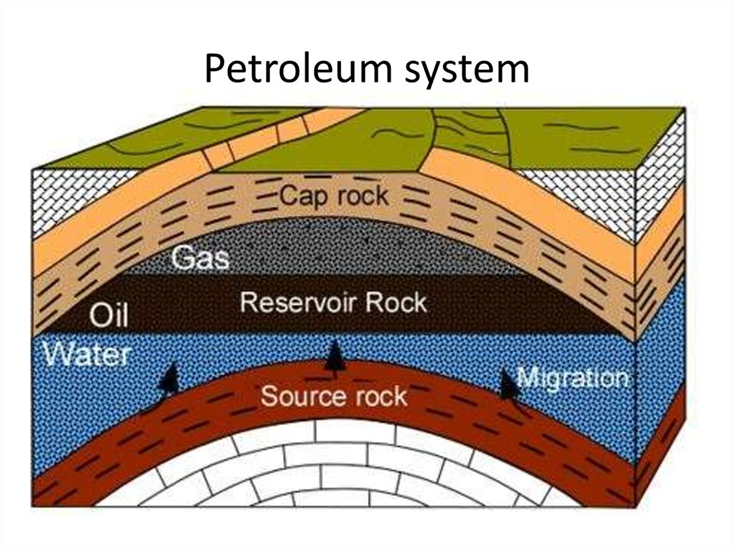
There are four main geological parts that make up any petroleum system (AAPG, 1999):
- Source Rock: A rock layer, typically organic-rich shale, containing sufficient organic matter that, when subjected to heat and pressure over geological time, generates hydrocarbons.
- Reservoir Rock: A porous and permeable rock layer, such as sandstone or certain limestones, that has the capacity to store migrated hydrocarbons within its interconnected pore spaces.
- Cap or Seal Rock: An impermeable rock layer, such as a dense shale or salt, that drapes over the reservoir rock and acts as a cap, preventing the buoyant and highly mobile hydrocarbons from escaping to the surface.
- Trap: A specific geometric arrangement of rock layers; such as an upward-arching fold (anticline) or a fault-bound block; that concentrates the migrating hydrocarbons into a finite, exploitable accumulation.
These elements are static until activated by two critical geological processes: the formation of the trap itself and the subsequent generation, migration, and accumulation of hydrocarbons from the source rock into that trap. The perfect alignment of these factors is the blueprint for discovery, a model that can be applied to basins worldwide, including the tectonically complex Himalayan foreland basin (Friedenreich et al., 1994).
3. Petroleum in nepal: Assessing the Geology
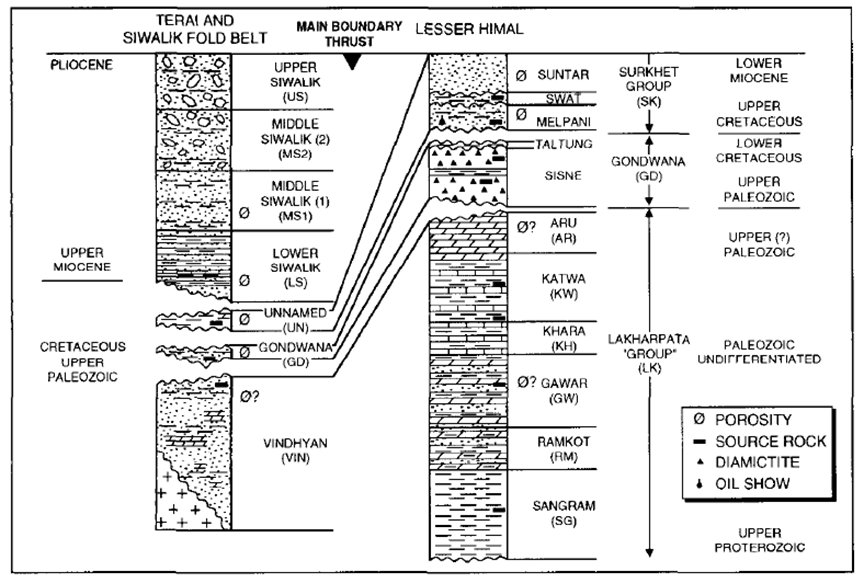
By applying the petroleum system model, geoscientists can systematically evaluate the hydrocarbon potential of a frontier region like Nepal. Decades of research by the Department of Mines and Geology (DMG) and its partners (Friedenreich et al., 1994; Bashyal, 1998) have uncovered compelling evidence suggesting that the key elements for a functional petroleum system are indeed present within the country’s sedimentary basins (Figure 2).
3.1. Evidence of Source Rocks
A critical prerequisite for any petroleum system is a viable source rock. In the Karnali-Bheri region of Nepal, the primary candidate is the Lakharpata Group (also described as Subgroup), a sequence of rocks dating from the Neoproterozoic to Late Paleozoic eras. Within this group, the Sangram Formation, consisting of dark, organic-rich shales containing up to 9% Total Organic Carbon (TOC)is particularly promising (Bashyal, 1998). However, the Late Cretaceous to Early Miocene Surkhet Group is the most targeted because of the TOC values of 2 to 20% (Subedi et al., 2012). These are remarkably high values, given that 2-4% TOC is considered good and anything above 1% warrants investigation (AAPG, 1999; Shelly & Sonnenberg, 2014). The high organic content is further confirmed by the local practice of burning some of these shales for fuel, a clear indicator of their hydrocarbon-generating potential.
3.2. Surface Indicators and Seepages
The most direct and compelling evidence of an active petroleum system comes from surface manifestations of oil and gas. In Nepal, numerous oil and natural gas seeps are recorded in the Dailekh region, specifically in the areas of Padukasthan, Sirsethan, and Navisthan. Natural gas seeps are also known to occur at Muktinath in the Mustang district (Kaphle, 2020). These seepages are the definitive surface expression of an active petroleum system, proving that the geological engine for hydrocarbon generation is not only present but currently operating in the subsurface. This clear evidence of natural potential has logically driven a long history of exploration efforts.
4. History of Exploration in Nepal
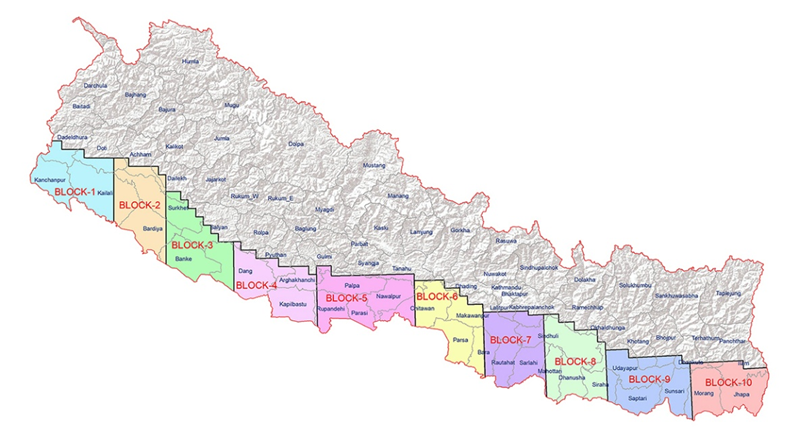
While interest in Nepal’s petroleum resources has existed for decades, a concerted, scientific effort to explore them has evolved over time. The Government of Nepal (GON), through the Department of Mines and Geology (DMG), has prioritized petroleum exploration since 1982 (Kaphle, 2020). The Terai region was surveyed by dividing it into ten blocks from west to east (Figure 3). Early phases involved partnerships with international oil companies, but these firms were often reluctant to conduct extensive fieldwork and ultimately departed the country in 2013 without making significant progress.
In 2019, a national commitment renewed with the technical cooperation agreement between the Government of Nepal and the Chinese Government. This partnership moved beyond reconnaissance, focusing on a data-driven, systematic evaluation of the basin’s most promising area, beginning with a comprehensive 400 square-kilometer seismic survey designed to delineate subsurface traps in the Dailekh district (Fiscal Nepal, 2025; Lagani News, 2025). In conjunction with this geophysical work, a joint Nepalese-Chinese team collected numerous rock, soil, and gas samples for detailed geochemical analysis, setting the stage for a major breakthrough.
5. The Dailekh Discovery
The diligent exploration efforts in Dailekh culminated in a pivotal announcement in 2025, marking a potential turning point in Nepal’s economic and energy history. The preliminary findings from the joint Sino-Nepalese project confirmed the discovery of a massive natural gas reserve, positioning Nepal to transition from a net energy importer to a nation with significant domestic resources.
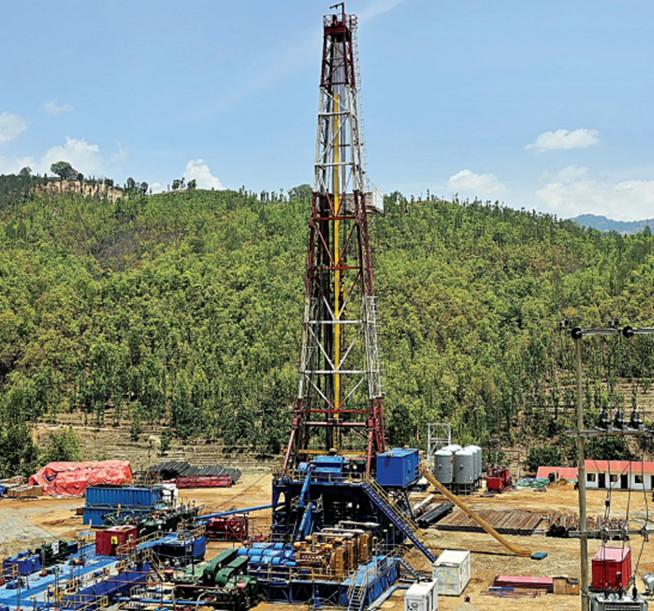
Drilling to a depth of 4,000 meters successfully penetrated the thick Siwalik foreland sequence, likely reaching the underlying source rocks or reservoirs charged by them, validating the geological model that predicted deep hydrocarbon potential beneath the surface seeps.
The key details of this landmark discovery are:
- Volume: An estimated 112 billion cubic meters of natural gas.
- Composition: The gas is primarily methane, a clean-burning and versatile energy source.
- Location: The discovery was made in Jaljale, Dailekh district.
- Exploration Team: The work was conducted by a Chinese geological team from the China Geological Survey in partnership with CNPC Xibu Engineering Company.
- Methodology: The discovery followed the drilling of an exploration well to a depth of 4,000 meters, a process that commenced on May 11, 2023.
Methane gas discovered in this area has potential to be used to run vehicles, generate electricity, and provide household lighting. In addition, hydrogen and ammonia can be extracted, which is essential for producing chemical fertilizers. Nepal Oil Corporation has been keen in expanding its business by trading methane and manufacturing chemical fertilizers.
6. Future Outlook and National Implications
The Dailekh discovery has changed the story about Nepal’s energy supply from one of theoretical potential to one of proven reserves. This breakthrough opens new strategic avenues for national energy policy and economic development. The preliminary estimate that the reserve could meet Nepal’s domestic energy needs for up to 50 years provides a tangible pathway toward long-term energy independence and security, reducing reliance on costly imports and insulating the economy from volatile global energy markets. Although the final report has not been published yet, this geological validation significantly derisks exploration in other structurally similar subbasins, transforming them from speculative concepts into tangible, data-driven prospects and positioning Nepal as an emerging player in the regional energy landscape.
References
- AAPG. (1999). Exploring for oil and gas traps. (E. A. Beaumont, & N. H. Foster, Eds.) Tulsa, Oklahoma, U.S.A.: The American Association of Petroleum Geologists (AAPG).
- Bashyal, R. (1998). Petroleum exploration in Nepal. Journal of Nepal Geological Society, 18, 19-24.
- Fiscal Nepal. (2025, June 19). Massive natural gas reserve discovered in Nepal: 112 billion cubic meters found in Dailekh. Retrieved from Fiscal Nepal: Business news at your fingertips: https://www.fiscalnepal.com/2025/06/19/20780/massive-natural-gas-reserve-discovered-in-nepal-112-billion-cubic-meters-found-in-dailekh/
- Friedenreich, O., Slind, O., Pradhan, U., & Shrestha, R. (1994, December). Petroleum Geology of Nepal. Canadian journal of exploration geophysics, 30(2), 103-114.
- Hyne, N. J. (2012). Nontechnical guide to Petroleum Geology, Exploration, Drilling and Production (Third ed.). Tulsa, Oklahama: PennWell Corporation.
- Kaphle, K. P. (2020). Mineral Resources of Nepal and their present status. Retrieved from Nepal Geological Society: https://ngs.org.np/
- Lagani News. (2025, September 2). Petroleum exploration in Dailekh: Detailed report of the sample awaited. Retrieved from Lagani News: https://laganinews.com/en/2025/09/02/petroleum-exploration-in-dailekh-detailed-report-of-the-sample-awaited-2/
- Shelly, R. C., & Sonnenberg, S. A. (2014). Elements of Petroleum Geology (Third ed.). Elsevier.
- Subedi, D. N., Mahato, S. P., KC, S. B., & Ghimire, J. R. (2012). Oil and gas Exploration Activities in Nepal. ASEG Extended Abstracts, 1-4. doi:10.1071/ASEG2012ab050
(A version of this article was first published on Nepal Oil Corporation‘s annual publication ‘Prabhat 2082’.)
Leave a Reply